Three questions about length generalization
A transformer trained to recognize balanced parentheses on short strings may be evaluated on longer strings. Understanding this setting requires separating what the model can represent, what training identifies, and where the resulting computation remains correct.
One possibility is that it has discovered a computation whose instructions do not depend on input length. C-RASP makes such computations explicit: a fixed sequence of operations acts on a vector with one entry per input token. Longer inputs produce longer vectors, not longer programs.
Representability
Does a transformer exist that computes the target?
Learning
Does training find a solution on the observed inputs?
Length generalization
Does that solution also work beyond the training lengths?
These are different questions. A construction answers the first; it does not, on its own, answer the other two. The following sections discuss these questions separately.
Recognizing balanced parentheses with C-RASP
The language Dyck-1 consists of correctly balanced strings using one kind of parenthesis. For a nonempty input, two conditions characterize membership: no prefix contains more closing than opening parentheses, and the complete input has equally many of each. The first condition checks the order; the second checks that every opening parenthesis is eventually closed.
For example, ()(()) satisfies both conditions. The string
())(() has the same final counts, but its prefix ()) already
contains too many closes. A test that only compares the totals would miss this
violation.
From a sequence to vectors
A C-RASP assignment produces a vector with one entry per token position. A Boolean vector records a yes/no answer at each position; a number vector records an integer. Operations combine entries at the same position, or count how often a Boolean predicate is true in the prefix. A prefix includes the current position.
The walkthrough starts with Opens, the number of opening parentheses seen
so far. Its values on ()(()) are 1, 1, 2, 3, 3, 3. The
program then constructs the closing counts, detects invalid prefixes, and combines the
two acceptance conditions. All seven assignments apply at every input length.
Follow the computation. Select Add next assignment to reveal one row at a time. Each column corresponds to an input position. Select a token or value to inspect the prefix used there. After reaching the final row, switch to the counterexample and look for the first violation. Rows are revealed gradually only in this walkthrough; the complete generated code is available below it.
Open the walkthrough in its own tab. Position labels in the activities start at 0. They use nonempty inputs; this choice is a scope limit of the interface, not a claim that Dyck-1 excludes the empty word.
Why the final check works
Violation is true wherever Opens < Closes. Counting those
positions produces Violations; checking that it is zero gives
Safe. This retains the history of an invalid prefix even if later tokens
make the totals equal. Separately, Balanced compares the two counts at
the current position. The final assignment is Safe AND Balanced.
At the last position, these checks express exactly the two conditions above. The argument does not depend on a maximum input length. This establishes what the program computes; it does not establish that training a transformer will discover it.
Experiment with C-RASP operations
The same operations can express tasks other than parenthesis recognition. In the
playground below, the initial program asks whether an input contains an
a. The first block marks positions containing a; the second
counts those marks; the third checks whether the count is greater than zero. The
decision is read at the last token.
Build without writing syntax. Click or drag an operation from the palette to add a block. Choose its inputs from the menus and read the resulting vector directly beneath it. Only earlier variables of a compatible type are offered. A count consumes yes/no values and produces numbers; a comparison consumes numbers and produces yes/no values. Values update immediately when you edit the program or input.
Start by changing the token test from a to b. Then try the
starter that requires both symbols: which extra checks are needed? Finally, compare it
with the starter asking whether an a occurs before a b. Test
a b and b a. Both have the same totals, but prefix
information distinguishes their order. This starter does not require adjacency.
Open the block playground in its own tab. The interface provides a subset of C-RASP: token tests, prefix counts, comparisons, Boolean combinations, and addition. Its limits of 24 blocks and 16 tokens are interface limits, not bounds on the language.
What a well-formed program tells us
The block editor prevents syntax errors, incompatible inputs, and references to variables that have not yet been defined. These checks do not ensure that a program solves the intended task. A program that only checks equal totals is well-formed, but it does not recognize Dyck-1. Changing inputs and inspecting vectors helps find counterexamples; a correctness argument is still needed for all lengths.
Full C-RASP also includes operations such as subtraction, min/max, and conditional selection. The important feature for this tutorial is that a fixed finite program specifies a sequence of vector operations independently of input length. The next section explains how transformer layers can represent such operations.
Representing counts with uniform attention
Construction intuitionThe walkthrough used exact integer counts. To connect this to a transformer construction, consider a head whose attention scores are zero at every visible position. Softmax then assigns equal weight to every position. If the values encode a Boolean predicate, the result is its frequency in the prefix.
Counts at the same position share a positive denominator, so their ordering is preserved. A BOS-only indicator has sum 1: averaging it supplies 1/(i + 1), the encoded integer constant 1.
Reading the attention illustration. The sequence is fixed to
()(()). Move the slider to change the number of ordinary tokens visible
to attention. The marked prefix also includes BOS, so each visible position receives
weight 1/(i + 1). The two fractions show the normalized opening-parenthesis count and
the normalized constant 1. This illustrates the arithmetic of the construction; it is
not attention measured in a trained model.
Each box shows its value for “is an opening parenthesis” and its attention weight. Muted boxes are outside the visible prefix.
BOS contributes zero to the opening-parenthesis count and one to the constant indicator. Tokens outside the prefix receive no weight.
Precision and LayerNorm
Adjacent normalized counts differ by 1/(i + 1). Resolving them through length n motivates O(log n) fractional precision for these values. This is a resolution argument, not a proof that rounding every intermediate activation preserves a complete simulation.
Yang and Chiang account for LayerNorm using paired coordinates with opposite signs and additional comparison machinery. The full construction is more than simply applying an unscaled comparison to an attention output.
Positional information and its restrictions
C-RASP[Φ, Ψ] adds unary predicates on positions and binary relations that restrict counting. Throughout this article, C-RASP[Pos] abbreviates the paper’s C-RASP[periodic, local]: periodic unary predicates, and translation-invariant local binary relations. Unrestricted prefix counting remains available separately.
Periodic
A pattern repeats after a fixed number of positions. An infinite sequence can have a finite description.
Translation-invariant
Shifting both positions equally does not change their relation.
Local
The additional positional relation is false beyond a fixed distance.
Comparing positional relations. The boxes represent positions 0 through 11. The arrow marks the query position i; highlighted boxes are keys j selected by the chosen relation within the causal prefix j ≤ i. Change the query position to see how the selected keys move. The preceding-token relation satisfies both restrictions. The other options illustrate what fails when locality or translation invariance is removed; they are not all allowed relations in C-RASP[Pos].
Query = the position doing the counting. Selected = a position that contributes if its token predicate is true. Masked = a later position excluded by causal attention.
A preceding-token relation is both local and translation-invariant. Even distance is translation-invariant but not local. These restrictions concern the additional positional interaction; content-based attention can still aggregate over an entire prefix.
Where limit transformers enter
Learned absolute positional embeddings occupy a finite table. To analyze growing context lengths, Huang et al. introduce limit transformers: fixed-width mathematical models defined at arbitrary lengths, with positional vectors and additional positional attention functions.
For the theorem, the vectors are periodic and the additional functions are translation-invariant and local. Every C-RASP[Pos] program can be compiled into a limit transformer with these properties. The converse expressive equivalence is not established.
Identification under an idealized inference procedure
Theorem · Idealized inferenceFor context length n, imagine choosing a transformer that matches the target on every input of length at most n/2, at every valid offset. Among admissible exact fits Un, choose one with nearly the smallest complexity regularizer:
An exact minimum need not be attained. The vanishing allowance makes the selection rule well-defined whenever suitable fits exist. The hypothesis class also restricts positional parameter products to be offset-independent; regularization alone does not impose that condition.
Under the paper’s assumptions, representability by a periodic, local limit transformer is equivalent to eventual length generalization with uniformly bounded regularizer values for any sequence selected by its inference procedure. Both bounded complexity and eventual generalization matter.
Intuitively, bounded complexity leaves finitely many underlying candidate algorithms. Every candidate that disagrees with the target has a finite counterexample. Increasing the training length eventually exposes those counterexamples.
Read the assumptions before applying the theorem
This is not a guarantee for SGD on sampled training data. The learner fits all shorter inputs, approximately minimizes a specific regularizer, and operates in a restricted hypothesis class. The paper’s model uses length-scaled attention, specified rounding of logits and exponentials, and ReLU/Heaviside activations. Its initial analysis allows infinite-precision activations.
“Matching” is defined for the paper’s output functions, not merely equal accuracy on a finite test set. A Boolean recognition formulation requires a compatible output encoding. The theorem is about identified computations, not convergence of learned matrices to unique weights.
Empirical length-generalization results
Expressibility is a theoretical property. Generalization accuracy is an observation about a particular training setup. The figures below reproduce results reported by Huang et al. (2025). The separate gallery supports inspection of additional saved evaluations.
Reading the published plots. Each panel compares accuracy across three length bins. Use the buttons to switch between the overview and the version labeling individual regular languages; click the figure to view it at full size. Solid and dotted lines distinguish positional-embedding settings. The caption below explains the training and model-selection ranges and the meaning of the colors.
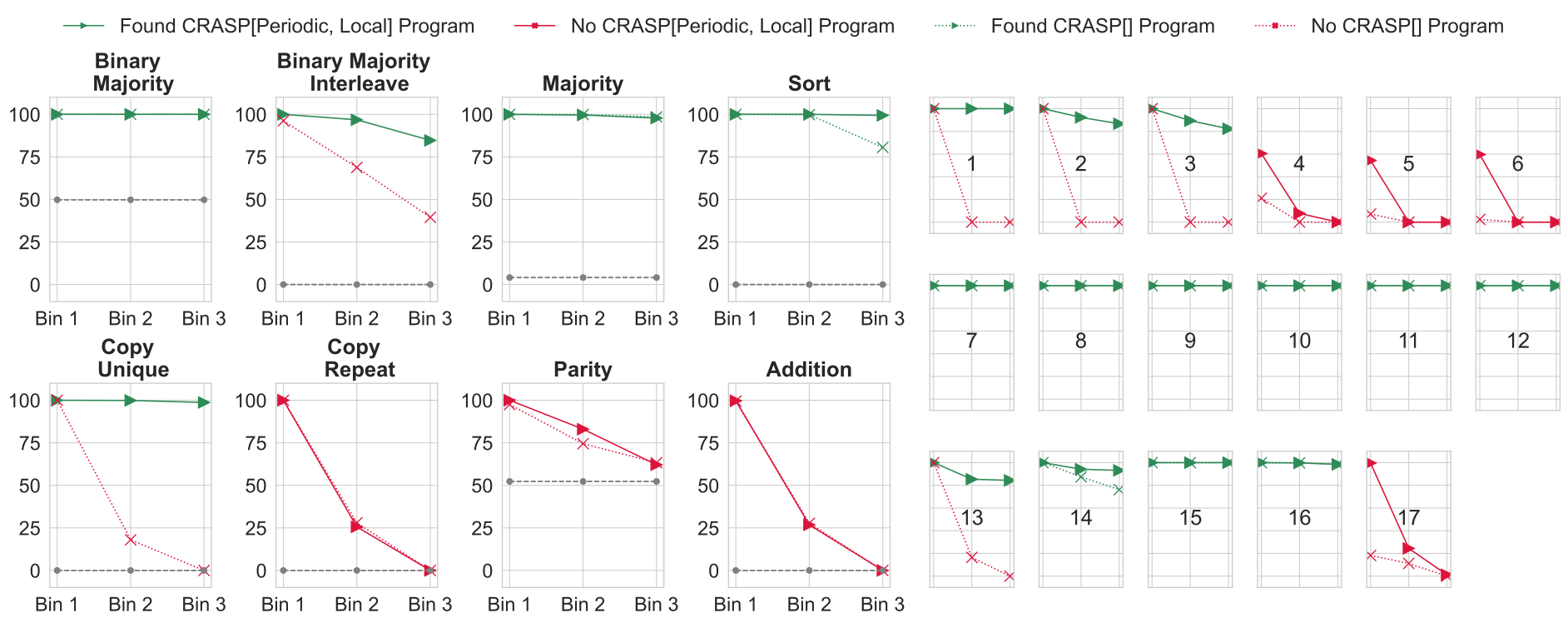
Source: A Formal Framework for Understanding Length Generalization in Transformers, arXiv v2, CC BY 4.0. Original SVGs, unchanged. Training lengths are ≤50; hyperparameters were selected using performance through 100, so [101,150] is the later generalization evaluation. Green indicates a program was found; red includes both proved nonexpressibility and cases where no program was found. Accuracy requires all predicted positions in an example to be correct. These plots do not prove learnability.
Additional saved evaluations
To inspect a run, import a JSON file and select it from the run menu. The plot shows whole-sequence accuracy against input length, with the training range shaded and, when recorded, the model-selection range marked separately. The table gives the underlying correct and total counts. Each curve corresponds to one checkpoint and seed; connecting lines do not represent additional measurements. No additional runs are included in this edition.
Import a JSON file matching the evaluation schema. Files are read locally in your browser. No training or evaluation jobs are started. Each curve represents one run and its recorded checkpoint.
Missing evaluations are unavailable—not zero accuracy.
Scope and limitations
C-RASP supplies concrete algorithms, a route to transformer constructions, and a sufficient condition for the idealized identification theorem. It does not tell us that ordinary training will discover the intended algorithm, nor that a successful finite evaluation establishes correctness at all lengths.
There is also no general computable training-length bound in terms of description size for unrestricted C-RASP—even at counting depth two. Yang et al. (2026) identify a positive fragment, C-RASP₊, for which worst-case optimal exponential bounds do exist. Its restricted count comparisons and the corresponding fixed-precision transformer model matter to that result.
The examples above expose the computation specified by a program. Determining whether a trained transformer implements that computation requires additional evidence beyond agreement on the displayed inputs.
Sources & notation
- Andy Yang and David Chiang (2024). Counting Like Transformers: Compiling Temporal Counting Logic Into Softmax Transformers. COLM.
- Xinting Huang et al. (2025). A Formal Framework for Understanding Length Generalization in Transformers. ICLR.
- Andy Yang, Pascal Bergsträßer, Georg Zetzsche, David Chiang, and Anthony W. Lin (2026). Length Generalization Bounds for Transformers.
- Hattie Zhou et al. (2024). What Algorithms Can Transformers Learn? A Study in Length Generalization. ICLR. Empirical motivation and the RASP-L conjecture.
Glossary
- Predicate
- A Boolean value at each position.
- Prefix count
- The number of positions satisfying a predicate, including the current position.
- BOS
- A beginning-of-sequence token. Its indicator supplies a reference for normalized constants.
- APE / NoPE
- Learned absolute positional embeddings / no explicit positional embeddings.
- C-RASP[Pos]
- This article’s abbreviation for C-RASP[periodic, local], not unrestricted positional access.
- ℛ
- The framework’s complexity regularizer. A uniform bound is independent of context length.